AI Calorie Estimation Accuracy: What to Expect

AI calorie tracking is faster than manual logging, but people still ask the same question first: "How accurate is it really?"
This guide breaks down where AI calorie estimation is strong, where it fails, and how the most discussed tools compare on real meals.
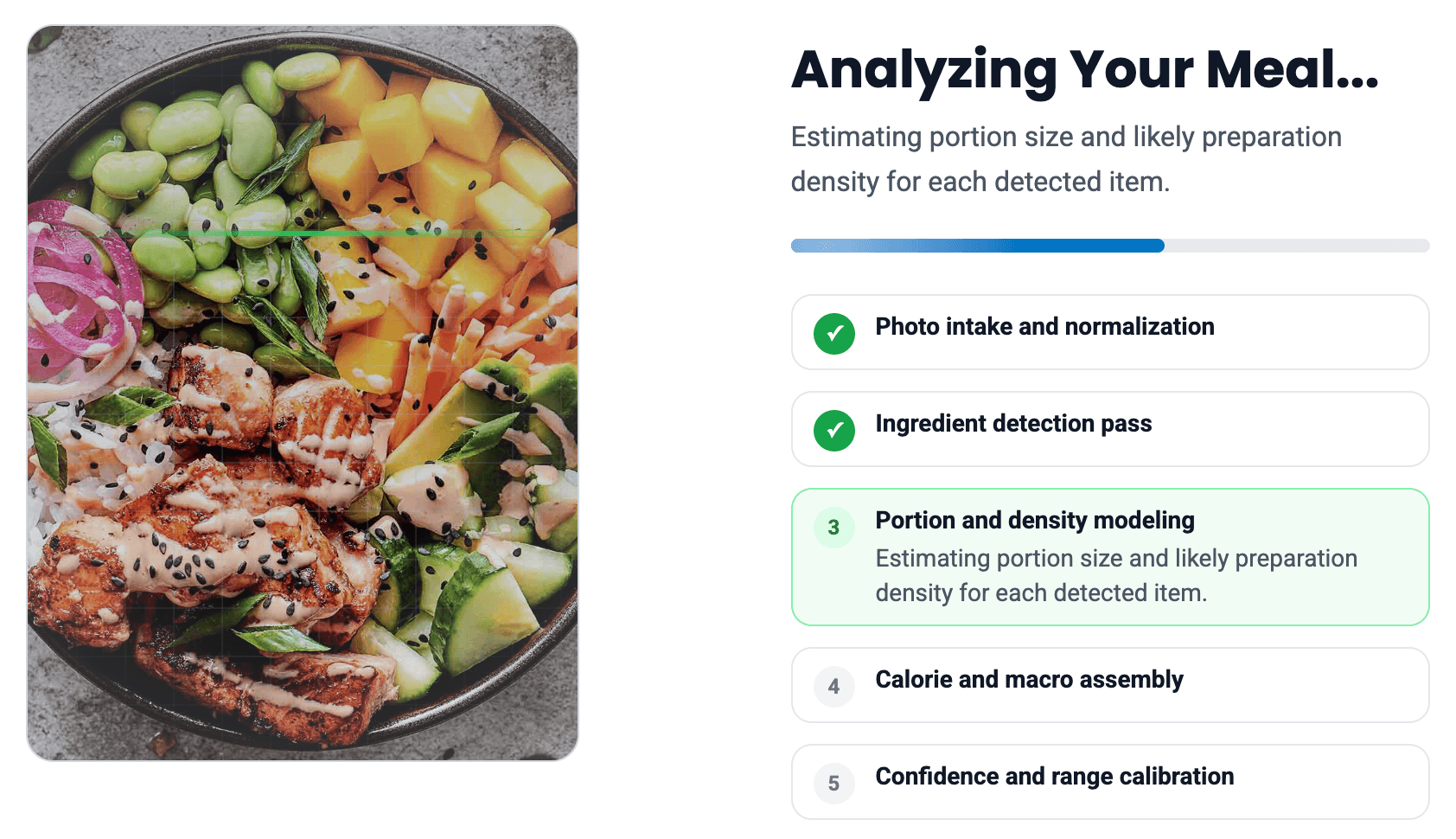
At-a-glance summary
- AI calorie estimation combines machine learning and computer vision to identify foods, estimate portions, and predict calories.
- On simple foods, many tools can land within roughly 10-20% of expected calories.
- On mixed or complex dishes, error can rise substantially, in some reports up toward 38.3%.
- Hidden oils, sauces, and poor scale references are common reasons estimates run low.
How AI calorie estimation works
Most AI food trackers follow a three-stage pipeline: food recognition, portion-size estimation, and nutrition mapping. First, the model predicts what foods are likely in the image. Next, it estimates volume and serving size from visual cues. Finally, it maps those estimates to a food database to calculate calories and macros.
This process is fast and useful, but still inference-based. The tool estimates what it cannot directly measure from a photo.
Quick comparison
| Tool | Strengths | Weaknesses |
|---|---|---|
| What The Food | Multi-item analysis, recipe generation, macro tracking | Free tier limits and reduced reliability on complex dishes |
| Snap Calorie | Strong recognition and depth-assisted portion workflow | Portion-size estimation can still be inconsistent on some meals |
| Cal.ai | Fast processing and barcode support | Undercount risk and occasional editing/save friction |
| MyCalorieCounter | Solid results for simple single-ingredient foods | Weaker performance on mixed or homemade complex meals |
Which AI photo calorie tracker looks most accurate?
Based on commonly cited public claims, Snap Calorie is often positioned as one of the strongest performers for overall recognition and portion handling. That said, no app is universally best for every meal type.
If your meals are simple and repetitive, several tools can perform well. If you eat mixed dishes, restaurant meals, or heavily sauced foods, all apps require more caution.
Tool-by-tool breakdown
1. What The Food
What The Food is strong on straightforward meals and useful for people who want calories plus macro context in one place.
- Accuracy: competitive on simple foods; weaker on complex, layered dishes.
- Complex meals: can miss hidden oils, dressings, or secondary ingredients.
- Portions: relies on visual cues, so unclear scale references reduce reliability.
- Extras: recipe generation, macro tracking, nutrition breakdowns, and planner-style features.
2. Snap Calorie
Snap Calorie emphasizes model quality and depth-assisted portion estimation. Publicly shared figures often cite about 15% mean error in representative scenarios.
- Accuracy: generally strong positioning vs common alternatives.
- Complex meals: attempts to account for hidden ingredients using dish-level priors and visual cues.
- Portions: depth-enabled workflow can improve volume estimation, but results still vary by meal and photo.
- Extras: health integrations and free daily scan limits before premium tiers.
3. Cal.ai
Cal.ai is popular for scan speed and convenience. It works best when food structure is simple and clearly visible.
- Accuracy: tends to be higher on simple foods, lower on mixed or homemade dishes.
- Complex meals: hidden fats and layered ingredients can drive underestimation.
- Portions: image-based volume estimation can vary significantly when plate geometry is unclear.
- Extras: barcode scan flow, meal memory, and progress features.
| Food category | Estimated accuracy rate |
|---|---|
| Simple foods (fruit, plain meat) | ~87% |
| Packaged foods (visible labels) | ~82% |
| Standard restaurant meals | ~72% |
| Mixed meals (salads, casseroles) | ~62% |
| Homemade or ethnic mixed dishes | ~50% |
4. MyCalorieCounter
MyCalorieCounter is usually most dependable on single-item foods, but gets less stable as meal complexity increases.
- Accuracy: often acceptable for plain, single-ingredient foods.
- Complex meals: hidden fats, dressings, and mixed textures can reduce reliability.
- Portions: requires clear, well-lit photos for best volume estimates.
- General fit: fine as a simple tracker, less ideal for dense restaurant or homemade mixed meals.
Why volume estimation is still the hardest problem
Across platforms, volume and portion estimation remains a key bottleneck. In some edge cases, large errors are still possible, especially when foods overlap, stack, or hide high-calorie ingredients.
"Important obstacles to accurate food quantity estimation still need to be solved before these tools fully replace traditional dietary assessment methods."
How to get better results from AI calorie apps
- Use clear, bright, even lighting.
- Capture the full plate, plus sauces and sides.
- Use a repeatable top-down or 45-degree angle.
- Include a familiar scale reference when possible.
- Retake photos if ingredients are heavily occluded.
- Cross-check complex meals with manual edits.
AI calorie counters are best treated as educational, behavior-support tools. Used consistently, they help you build better portion judgment and improve long-term nutrition awareness.
Conclusion
If your meals are mostly simple, AI calorie estimation can be surprisingly useful and efficient. If your meals are complex, heavily dressed, or restaurant-based, treat results as directional and verify when needed.
Progress beats perfection. The best app is the one you can use consistently enough to spot patterns and make better nutrition decisions over time.
References
Frequently Asked Questions
Answers to common questions about AI calorie estimation accuracy, meal complexity, and portion-size reliability.